
Connect customers to the right agent, every time.
Design IVRs on an intuitive visual canvas and resolve inquiries at the first touchpoint by automatically routing calls to the most relevant teams and agents.
Multi-level auto attendant
Guide callers through a structured phone menu that directs them to the right department, agent, or resource every time.
Unlike a single-level IVR, our multi-level auto attendant creates a “phone tree” with multiple layers, enabling detailed and efficient call routing.
Customize menus based on time of day, set up multi-level menus for precise call routing, and provide 24/7 self-service to reduce wait times and ease the workload on your team.
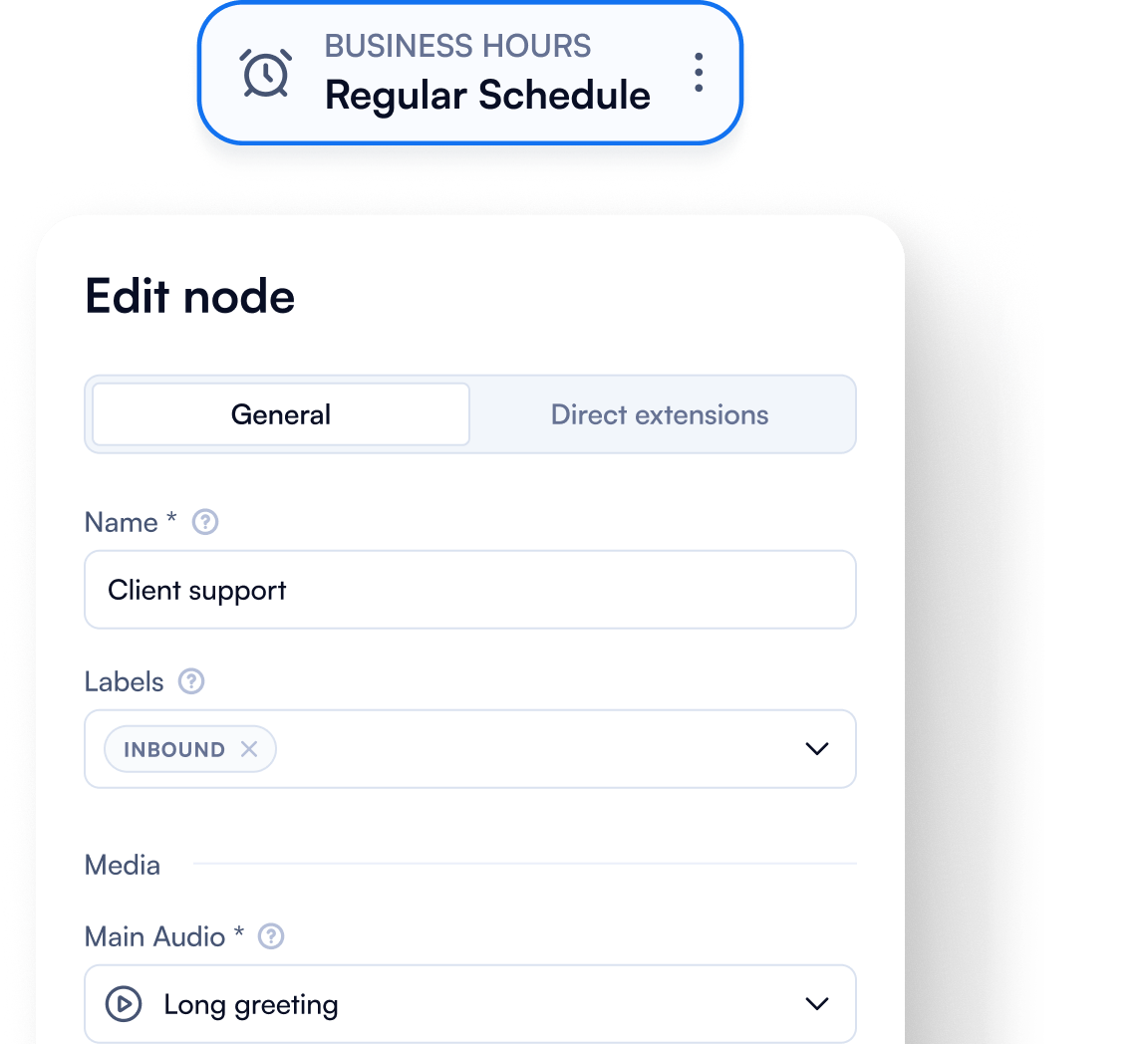
Voicemail & Customized Greetings
Add personalized greetings, messages, or on-hold music using text-to-speech, curated tunes, or your own audio files. Automatically route calls to voicemail when lines are busy, a department is unavailable, or outside business hours.
Share important announcements about hours, locations, or services while callers wait, all with multi-language support for a professional experience every time.

Advanced Analytics & Reporting
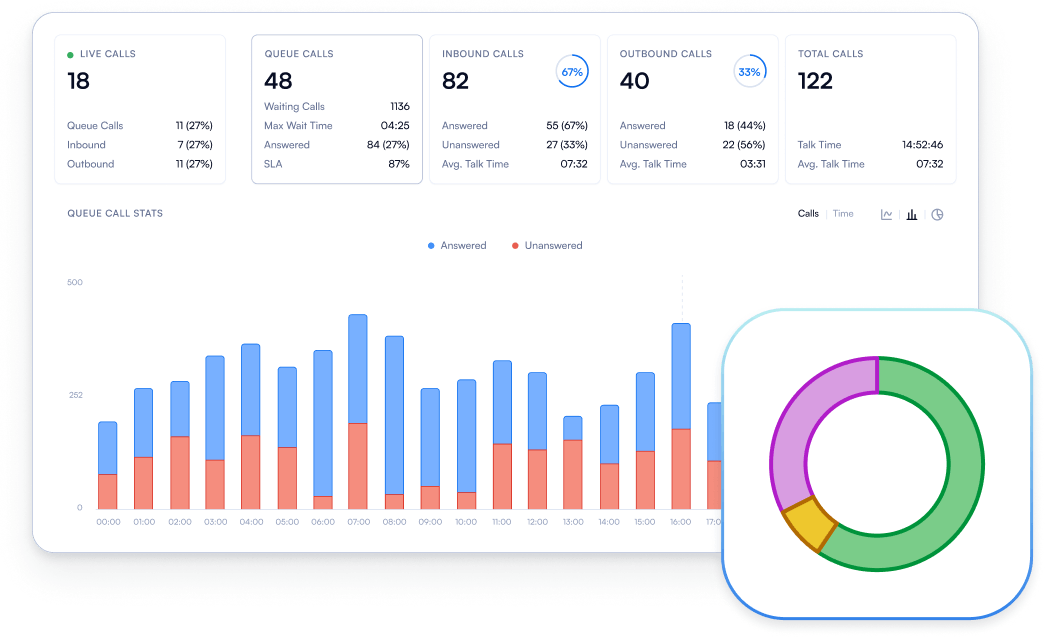
Get a clear view of your call activity with real-time dashboards, detailed SLA compliance reports, and AI-driven insights.
Track agent performance, monitor call volume, and uncover patterns that help improve customer satisfaction. Make data-driven decisions to optimize your team and deliver a consistently better calling experience.

Frequently asked questions about PBX.IM auto attendant services
What is an auto attendant?
What is an auto attendant?
Auto attendant - also known as an automated answering service - is an automated phone system that answers incoming calls and gives callers the option to connect to the right person or department.
For example, "For Customer Support, press 1." "For Billing and Payments, press 2."
Sub-menu options in auto attendant also enable callers to add more detailed information about their specific needs. For example, a sub-menu for Customer Support could include the following:
"If you are calling about an existing order, press 1.
If you need assistance with a new order, press 2.
For all other inquiries, press 3."
Usually, callers use their phone keypad or voice commands to navigate through pre-recorded messages and menus.
The auto attendant can also be configured to play a custom message to callers at selected menu levels.
PBX.IM’s auto attendant capabilities support simple and multi-level configurations (with sub menus), customized announcements, and direct extension dialing.
What are the benefits of using an auto attendant for a business?
What are the benefits of using an auto attendant for a business?
Using an auto attendant enhances both operational efficiency and improves customer experience.
First and foremost, it ensures 24/7 access to information and services outside of regular business hours enhancing customer satisfaction. It can also provide important information and options for emergency situations outside of business hours.
Businesses can improve call management efficiency with the help of automated call routing based on the caller’s input. This reduces the need for manual intervention and reduces wait times as callers can more quickly reach the appropriate extension or department without waiting for a human operator.
By automating call handling, businesses can minimize the need for receptionists or operators, reducing labor costs. Auto attendants can handle a high volume of calls, all without creating staffing issues or additional costs.
Through call analytics, an auto attendant can collect data on call patterns, peak times, and common inquiries, providing valuable insights complementary to other customer support channels such as emails and chatbots.
It can also be configured to incorporate customer surveys and feedback options to gather opinions and improve service quality.
Many systems also offer multi-language support, allowing businesses to serve a diverse customer base more effectively.
What is the difference between auto attendant and IVR?
What is the difference between auto attendant and IVR?
While both share many common capabilities for handling incoming calls, there are several key differences between them:
- While auto attendant primarily uses keypad inputs for navigation, IVR uses both keypad inputs and voice commands for interaction.
- Auto attendant services provide basic call routing and information with limited to simple, pre-set options. IVR is capable of handling complex queries and providing self-service options.
- Auto attendants typically don’t integrate deeply with other systems. IVR often integrates with databases and backend systems to provide dynamic, real-time responses, and perform transactions.
- Auto attendant suitable for straightforward call routing and basic information dissemination. IVR is ideal for businesses requiring detailed interactions, data collection, and self-service capabilities.
How much does an auto attendant phone system cost?
How much does an auto attendant phone system cost?
Cost for an auto attendant system can vary significantly due to a number of factors. Some of the major variables include the following:
- initial setup costs,
- whether the platform is cloud-based or on premises,
- additional fees if new phone or hardware systems are required,
- whether customized development or integrations are needed,
- multi-language support.
With PBX.IM, all costs are upfront, there are no hidden fees!
A free DID number is provided for any new account and a test credit of $5 is included which can be used to test calls and make sure the system functions as intended.
A business will pay a monthly subscription fee to use the VoIP features plus any additional telecom fees incurred by their calls.
Call rates are visible in the rates page.
How to set up call queuing for success?
How to set up call queuing for success?
Call queuing is like many other business processes – it should be fine-tuned to meet the individual business needs and strategy. Current industry best practices include automated call distribution, using individual call data for training, and call forwarding.
It’s not just about the choice of on-hold music. Greetings, as well as other messages played while the customer is in the queue, should be as informative and useful as possible. Of course, hold times should not be extended to allow for more advertisements, but reduced as much as possible to quickly resolve issues or answer questions.
For real success, companies should be able to customize their VOIP system themselves without needing external specialists.